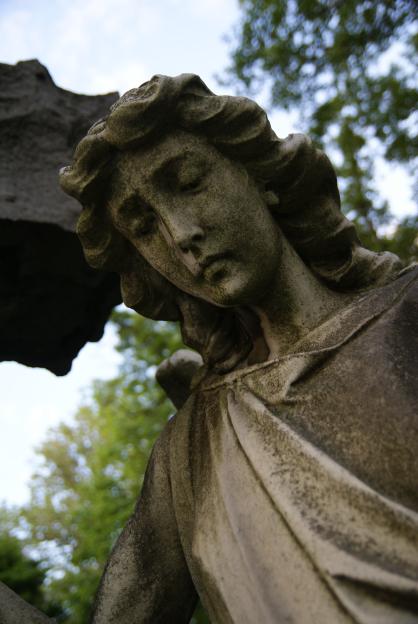
Dayton’s skyline
far surpasses the dreams of John Van Cleve,
one of the city’s important leaders and
Woodland’s founder. By the 1840s, Dayton was
outgrowing its original cemetery at Third
and Main Streets. Dayton’s pioneer families
faced the problem. The village was growing
and a larger, more suitable cemetery was
needed, preferably on some of the beautiful
wooded and rolling land with which Dayton
was surrounded. Selecting from thousands of
available acres, the original trustees, led
by John Van Cleve, chose 40 acres remarkable
for their hilltop views and their wide
variety of trees. Opening in 1843, it was
for that natural beauty that they chose to
call it “Woodland.” At that time those acres
seemed quite far from the center of the
little city. Little did they know that, in
the decades to come, Dayton would reach out
to Woodland and then surround it on all
sides.
In those days, Ohio was most popular for
settling because of the value of our farm
products. Southwestern Ohio had very good
farms and had the largest Ohio city,
Cincinnati, with a population of over
100,000. Dayton had about 20,000 people, one
out of every four being foreign-born, mainly
Irish and German, who had come to build the
Miami-Erie Canal in the 1850s. Half were
Ohio-born, with a few African-Americans.
Dayton was already becoming industrial with
the Barney & Smith Car Works, a leading
producer of railroad cars. Streets were
dirt, often mud, with wooden sidewalks. The
Courthouse downtown was the best building
there. It was built in the 1840s.

Today, Woodland’s 200 acres
make up one of
the nation’s oldest “garden” cemeteries. Its
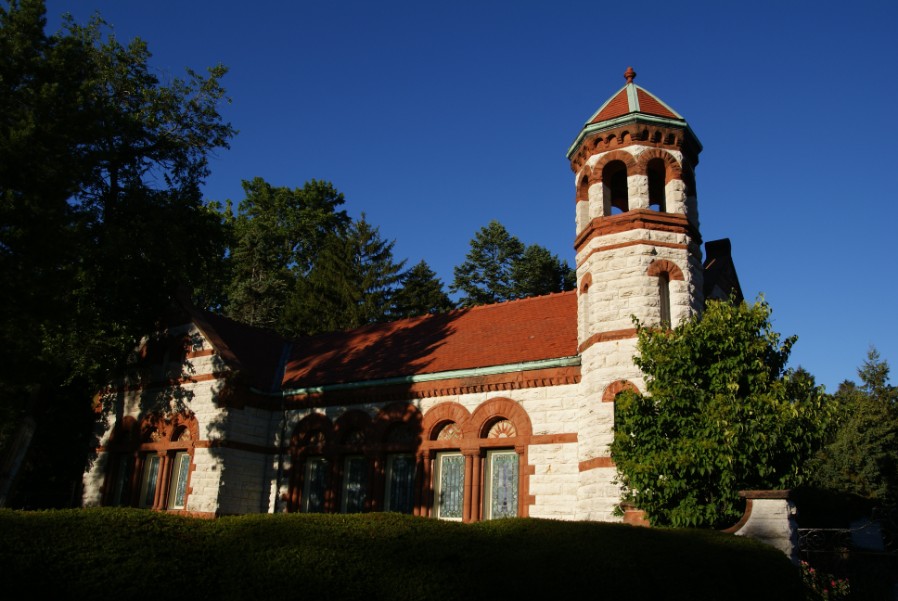
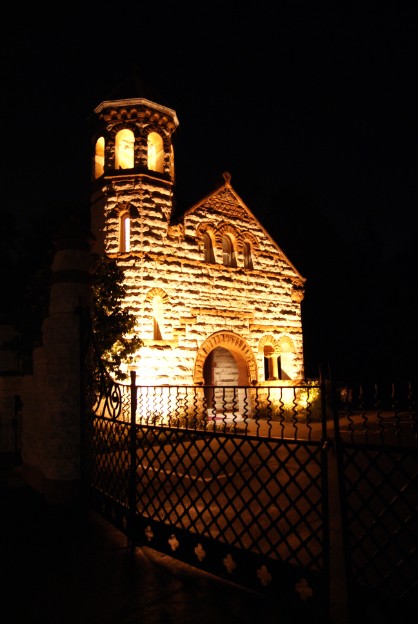
Romanesque gateway, chapel and office,
completed in 1889, are on the National
Register of Historic Places. The chapel has
one of the finest original Tiffany windows
in the country. 100,000 monuments, ranging
from rugged boulders to Greek statues and
temples, note the lives of people who helped
to shape a young nation and a young city.
With more than 3,000 trees on its rolling
hills, Woodland is recognized as one of the
area’s finest arboretums. Many of its trees
are more than a century old. Having burial
space for many years to come, Woodland
offers several types of burial services. In
the Garden of the Soaring Spirit, lawn
crypts provide the advantage of a modern
memorial along with a smaller burial space.
Other parts of Woodland
provide more
efficient use of the land, featuring
cremation and mausoleums. The beautiful
architecture of Woodland Mausoleum with its
rock and bronze face, features twenty-two
varieties of imported marble and twelve
large stained glass windows, inspired by
famous literary works. The crematory and
columbaria (storage for urns) in the
building give families more options for
remembering their loved ones.
Erma Bombeck Boulder
A 29,000-pound rock has become a monument
for writer Erma Bombeck’s grave. The massive
rock was brought here by flat-bed truck from
near her former home in Arizona. Her
husband, Bill Bombeck, said he wanted a
“piece of Phoenix” at Erma’s grave to
commemorate the 25 years they spent together
in Arizona.
Born Erma Louise Fiste in 1927 in Dayton,
Ohio, she worked for a daily newspaper while
in high school and while attending the
University of Dayton. After graduating she
became a reporter for the Dayton
Journal-Herald (which later became the
Dayton Daily News), where she also wrote
feature stories and a housekeeping column
for the women’s page, continuing until the
birth of her first child in 1953. By 1964
she was the mother of three, and returned to
her column appearing in more than 800
newspapers. Her witty-but-wise columns poked
fun at family life from her place as a
suburban housewife. One of her six best
sellers won the American Cancer Society’s
Medal of Honor in 1990 for advice to help
children survive cancer. This
internationally read humor columnist died of
complications following a kidney transplant
operation in 1996.
It is said that on cold nights that you can see the nostrils of Johnny Morehouses' dog breathing. If you're lucky, and it's cold enough, you can see his breath.
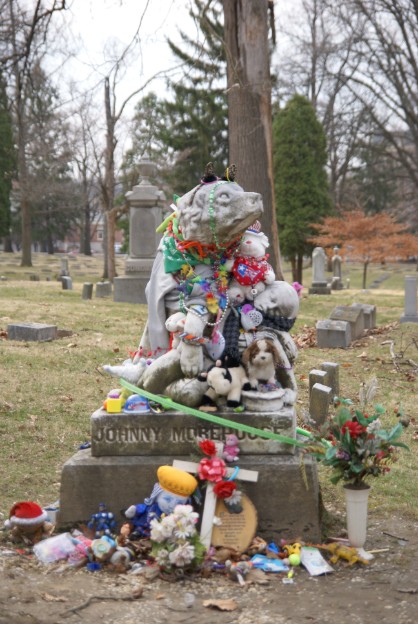
A Boy and His Dog
In the 1860s there was a boy, Johnny
Morehouse, the youngest son of John and Mory,
who lived with them in the back of his
father’s shoe repair shop. One day the
five-year-old was playing near his home by
the edge of the Miami & Erie Canal (which
used to run along the present Patterson
Blvd. in downtown Dayton near the library).
The boy accidentally fell into the canal
water. His dog, playing by him, jumped into
the water and tried to save him. He pulled
the boy out, but not in time to save his
life. The boy drowned and was buried in
Woodland Cemetery. Legend has it that,
several days after the burial, the dog
appeared next to the boy’s grave staying by
it morning, noon, and night. Visitors to the
cemetery saw him and began to worry about
his health. Some began leaving him bits of
food. Passersby still bring small toys and
other trinkets to decorate the grave marker
to express their spontaneous outpourings of
sympathy. Some visitors put money there. A
lady who walks the cemetery every day
collects the money and buys something for
the grave often. As you can see on his grave
marker, he already has toys to play with –
his harmonica, his top, his cap, his ball.
Beckel Beehive
This unusual beehive, or skep, is a monument
marking the final resting place of Daniel
Beckel, who lived from 1814 to 1862. Daniel
helped to start the first Dayton bank. He
was also the builder of the Beckel Hotel and
Opera House, a popular entertainment center
in Dayton in the mid 1800s. In funerary, or
monument art, a beehive represents having
good character and promising “abundance in
the Promised Land.” There is no other
connection to beehives known in Daniel
Beckel’s life.
Queen of the Gypsies
In 1856, Owen Stanley, king of gypsy tribes
in England, came to the U.S. with many of
his group because England was so thickly
populated. He wanted to make Dayton his
permanent home. He bought land in the City
of Dayton as well as Harrison, Wayne, Mad
River, and Butler townships so they could
raise horses and winter there, renting out
their farms while they took to the road as
soon as the weather became warm.Gypsies were a group of nomadic people whose
ancestors are said to have originated in
Eastern Europe. Within their groups they
have rulers, sometimes women, who decide
what is best for their tribe. British
gypsies had so many kings and queens – from
King John Bucelle in 1657 down to the Gypsy
Queen of the U.S., Matilda Stanley, royally
buried at Woodland Cemetery in 1878. It is
rare that such royalty would be buried here,
or that an American clergy would preach at
the funeral of a queen, but that happened.
Queen Matilda had died of cancer in
February. Her husband, Levi Stanley, son of
Owen Stanley, sent her body to Woodland to
be kept in a vault for burial in September.
Newspapers here and in many large American
cities sent special reporters who printed
long columns of accounts before and after
the funeral. The Sunday of the event,
thousands of people came in from surrounding
places by special trains. An estimated crowd
of 25,000 swarmed over the avenues and
grounds of the cemetery. Police were needed
to make way for the funeral procession. The
newspaper said a procession of 1000
carriages began downtown and was so long it
had to be refused admission at the cemetery
gates. Around the gravesite there were so
many people that the minister had to deliver
his sermon while standing on a wooden plank
laid across the open grave under an umbrella
in the rain. The king and his tribe, being
heartbroken, stayed around the Queen’s still
open grave as the great crowd left. Her
younger daughters were so upset that they
jumped down into the grave onto the marble
slab to be closer to their mother and sobbed
tenderly.
A granite monument marks the grave of King
Levi and Queen Matilda Stanley. Funerals of
the Stanley gypsies were quite elaborate.
They spared no expense to give their loved
ones dignity and show their regard for the
dead. The funeral coaches, the undertaker’s
hearse, a long procession, a rich casket,
and a great profusion of flowers were all a
part of the event. The women came dressed in
their best silks, satins, or velvets. Their
fingers were adorned with much gold. The
gypsy woman who possesses money does not
hesitate to buy expensive things when she
has set her heart on them. When you visit
the Stanley graves, look for the messages
and verses carved on their slabs, called
ledgers.
 |
In early times, many children died before
they were 10, women died in childbirth and
epidemics often killed several members of
the same family. The cemetery was a place to
“talk” to the deceased while honoring them
with flowers. Family picnics were
commonplace in large, park-like cemeteries.
The park-like cemetery remained popular
until about World War I. By that time, many
diseases had been conquered and early deaths
of family members were less common.
Cemeteries were rarely visited and often
neglected.
One tale of Woodland Cemetery is one of a young lady who sits alone on one of the park benches. Men have chased the ghostly gal only to catch nothing.
Woodland Time Line
1840
John Van Cleve initiates movement to
establish rural cemetery.
1841
First organizational meeting of subscribers
to new cemetery.
1843
Cemetery opened and lots offered for sale.
Cemetery dedicated on June 21. First
interment in cemetery on July 9.
1844
Work begun on sexton’s house, roads, fences,
etc.
1847
Receiving vault built as an Egyptian style
temple in the theme of Thebes and Karnak.
1848
Cholera epidemic, 225 burials.
1849
Plans for gateway, chapel, office. Stone
fence for cemetery. First high school in
Dayton. Courthouse at Third and Main
finished.
1850
Railroad comes to Dayton.
1851
James Hanna family and others removed from
an old burying ground at northeast corner of
Third and Main.
1852
Samuel Forrer, an engineer, makes survey of
cemetery grounds and lays out roads.
1861
Civil War (ended 1865). Dayton has 20,000
people.
1877
First well sunk. A steam pump raised water
to a reservoir on the summit.
Telephone invented by Alexander Graham Bell.
1878
New residence built for cemetery
superintendent. Old house used for office
and reception rooms.
1880
Dunbar publishes first book of poetry, Oak &
Ivy.
1881
Boonshoft Museum of Discovery begins as
Dayton Museum of Natural History.
1882
Carriages permitted in Woodland on Easter
Sunday.
1884
Spanish-American War (April to August 1898).
1885
Pumping station built on Wyoming St. to pump
water to summit.
1886
Plans for gateway, office and chapel
buildings, using stone from the cemetery
fence.
1903
First airplane flight by Wright Brothers.
1904
Window for north wall of Chapel installed by
Heinegke & Bowen of N.Y. (Tiffany Studios).
1908
35 acres of land purchased from University
of Dayton.
Tunnel built under Stewart
Street to connect it to main cemetery.
1909
Cemetery lot owners denied permission to
drive automobiles inside cemetery.
1910
Automobile hearses allowed in cemetery. Cars
and trucks purchased for cemetery work.
Rules prepared for autos in cemetery.
Kettering invented electric ignition for
cars.
1912
Shelter house and iron gates completed at
Waldo Street.
1913
Dayton flood. Fifty victims of flood
interred during March.
1915
Stone vaults, first used, purchased from
Portsmouth Stone Co.
1916
Dayton Daily News produces largest
single-day paper in world.
1917
U.S. entered World War I (ended 1918).
1918
Influenza epidemic.
1929
Stock market crash, the Depression begins.
1935
Wood box burials prohibited for adults.
1936
U.S. entered World War II (ended 1945).
World War II manpower shortage.
400 sheep
“employed” to keep grass “mowed.”
Discontinued next year because of
“difficulty in controlling natural grazing
habits.”
1950
Korean War (ended 1953).
1951
Pump house windows bricked and well filled,
no longer used after City water available.
1955
Kettering becomes a city.
1961
Acreage south of Stewart Street opened for
sale.
1965
Vietnam War (ended in 1973).
1968
Ground broken for mausoleum and crematory,
completed in 1970.
1969
First cremation in new crematory. First moon
walk.
1970
Bronze marker for Wright Brothers erected.
“Avenue of Flags” dedicated for all
veterans.
1974
Xenia tornado.
1976
Nation celebrates its 200th birthday;
Woodland celebrates its 135th birthday.
1978
The big blizzard.
1979
Main office building, gates, and old chapel
placed in National Register of Historic
Places.
1980
96-niche unit built at center of Lawn Crypt
area with bronze “Soaring Spirit” feature
statue placed above it.
1981
Land exchanged between cemetery, State of
Ohio (Mental Hospital grounds), and UD,
adding seven
acres of land bounded by
Wilmington Avenue and east line of Dayton
City Reservoir.
Lake drained to remove mud
and debris and repair banks.
1984
First computer purchased for cemetery. New
uniform signage system designed and erected.
1986
New park-like water stations installed.
1988
Stewart Street underpass renovated and
landscaped.
1990
Woodland documentary video produced.
1991
Woodland celebrates 150th birthday. $1.2
million building and renovation project
completed.
Woodland Arboretum Foundation
established. Woodland’s history book
written.
1995
Inaugural Board of Trustees of Woodland
Arboretum Foundation formed.
1996
Cemetery roadways resurfaced.
1998
Free audio tours offered by Arboretum
Foundation.
2000
Woodland Mausoleum renovated; Victorian
columbarium room and fountain added.
2001
www.woodlandcemetery.org.
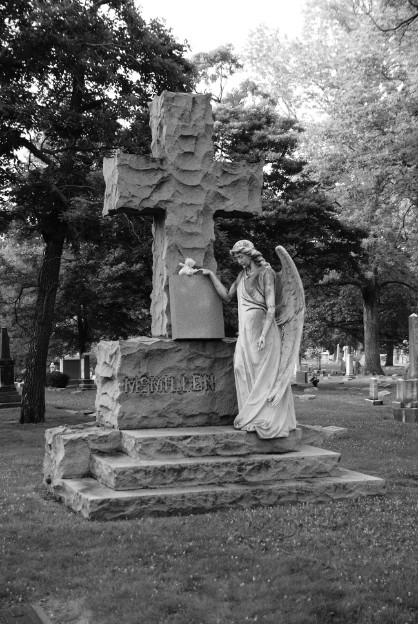
The area shown in the photo on the left is said to have had extremely high EMF readings (as high as 19 milligauss) as well as shadow people activity.
|