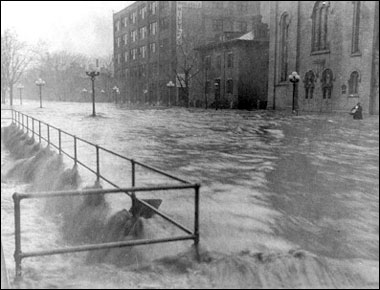
In March 1913, the citizens of the Miami Valley
witnessed a natural disaster unparalleled in the region's
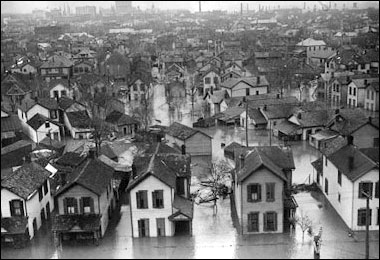
history. Within a three-day period, eight to 11 inches of rain fell
throughout the Great Miami River Watershed. This rainfall, coupled
ground already saturated from the melting of snow and ice of a hard
winter, produced more than 90-percent runoff, and caused the Great Miami
River and its tributary streams to overflow. Every city along the river
was inundated with floodwaters.
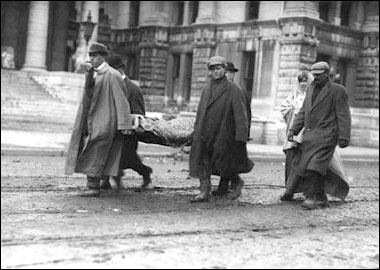
More than 360 people lost their
lives. Property damage exceeded $100 million (that’s more than $2
billion in today’s economy). The amount of water that passed through the
river channel in Dayton equaled the amount of water that flows over
Niagara Falls in a four-day period.
In the wake of the tragedy, the
citizens of the Miami Valley — who had lost virtually everything —
rallied to initiate plans for the prevention of future flooding. Some
23,000 citizens contributed more than $2 million to begin a
comprehensive flood protection program on a valley-wide basis.
To accomplish this feat, Arthur
Morgan, an engineer based in Memphis, Tennessee, was hired in May of
1913 to develop a regional flood protection system. The system would
protect the cities along the Great Miami River from persistent
flooding. The problem with the regional concept, however, was there was
no legal mechanism that allowed for its formation until a Dayton
attorney and Governor Cox, who was from Dayton, took matters into their
own hands.
Courtesy of the Miami Conservancy District
Dayton attorney John McMahon drafted the language
for the Conservancy Act legislation and lobbied for the passage of the
broadly powered piece of legislation that allowed the creation of
conservancy districts in the state of Ohio. Governor James Cox, owner
of the Dayton Daily News, signed it into law.
In February 1914, the Ohio General
Assembly passed the Conservancy Act of Ohio, which permitted the
creation of regional agencies to provide flood protection for
communities within the state.
Shortly after the law passed,
community leaders in the Miami Valley petitioned to form the Miami
Conservancy District. The Miami Conservancy District was formed in 1915,
and is among the oldest conservancy districts in the state.
As political subdivisions of the
state of Ohio, conservancy districts can form at the initiative of local
landowners or communities to solve water management problems, usually
flooding. In addition to flood protection, other approved purposes of
conservancy districts include conserving and developing water supplies,
treating wastewater and providing recreational opportunities. Chapter 6101 of the Ohio Revised Code authorizes the formation of Conservancy Districts.
Courtesy of the Miami Conservancy District
Dayton's Flood
Prevention Committee was a unique partnership among the Dayton business
community, the government and professional engineers. The committee
formed on May 2, 1913, shortly after the devastating 1913 flood, and
adopted a resolution to raise money to study the flooding problem and
find a solution.
John H. Patterson, president of the
National Cash Register Company, served as Flood Prevention Committee
Chairman and appointed the community leaders who served on the
committee. Colonel Edward Deeds led the committee, and Arthur E. Morgan
of Morgan Engineering Company of Memphis, Tennessee was hired to study
the flood control problem.
Flood Prevention Committee Members
|
|
 |
John Patterson was
perhaps the most pivotal leader during and after the flood. He shut
down his cash register factory to build boats to rescue stranded
residents from rooftops and attics. He used his factory land to house
and feed the homeless and helped raise the $2 million necessary for the
design of the flood protection program.
|
|
|
 |
Edward Deeds
held many important positions in Dayton's largest companies, including
president of the Dayton Engineering Laboratories Company (Delco),
president of the National Cash Register Company and president of the
Dayton Metals Products Company. Deeds led the Dayton Flood Prevention
Committee and was on the Miami Conservancy District's board of directors
from 1915 until 1954. He donated the office building that the Miami
Conservancy District currently occupies.
|
|
|
Walter Worman was president of The Dayton Spice Mills Company.
Edward W. Hanley was president of The Dayton Gas Company.
Walter S. Kidder was president of The Noyes Manufacturing Company and general manager of The Hayner Distilling Company.
H.E. Talbott was the president of The H.E. Talbott Company.
John W. Stoddard owned and operated the Dayton Motor Company, which built the Stoddard Dayton automobile.
Adam Schantz and Frank Huffman
were added to the committee upon the deaths of Worman and Hanley. Adam
Schantz was the president of The Dayton Breweries. Frank Huffman was
president of The Davis Sewing Machine Company.
The Dayton committee invited other
communities to cooperate in flood control work. On May 15, 1913, the
Miami Valley Flood Prevention Association, representing several
counties, was organized.
On February 17, 1914, Governor James Cox
signed a Conservancy Bill (the Vonderheide Act), which provided for the
creation of conservancy districts. The same month, 10 Miami Valley
counties petitioned for creation of a conservancy district: Butler,
Clark, Greene, Hamilton, Logan (which left shortly after formation),
Miami, Montgomery, Preble, Shelby and Warren. The Miami Conservancy
District was officially organized on June 28, 1915.
Courtesy of the Miami Conservancy District
|
|
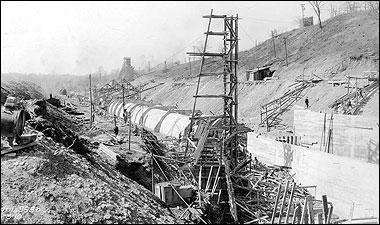
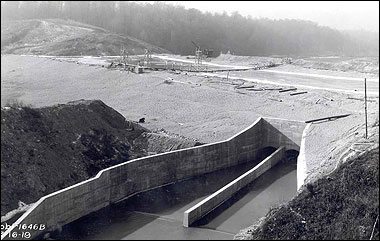
Courtesy of the Miami Conservancy District MCD built the flood
protection system between 1918 and 1922. The original system includes
five earthen dams, channel improvements and levees in Piqua, Troy, Tipp
City, Dayton, West Carrollton, Miamisburg, Franklin, Middletown and
Hamilton.
Construction of MCD’s flood
protection system was completed in an amazing five years, from
1918-1922. The Miami Conservancy District's flood protection system was
the largest public works project in the world of its time. It employed a
workforce of more than 2,000 people. The cost of the flood protection
system was more than $30 million. Careful attention to planning,
financing, legislation and implementation resulted in the most
comprehensive flood protection system in the nation.
Since completion of the original system in 1922, the dams have stored floodwaters more than 1,700 times.
MCD has
built several other flood protection projects at the request of
communities that had been subjected to flooding, including Miami Villa,
Miami Shores, Excello, Coleman Plat, Lower Stillwater. MCD also helped
complete an addition to the Middletown levee system. The residents of
these areas and local governmental agencies paid for these construction
projects.
Courtesy of the Miami Conservancy District
  |
|